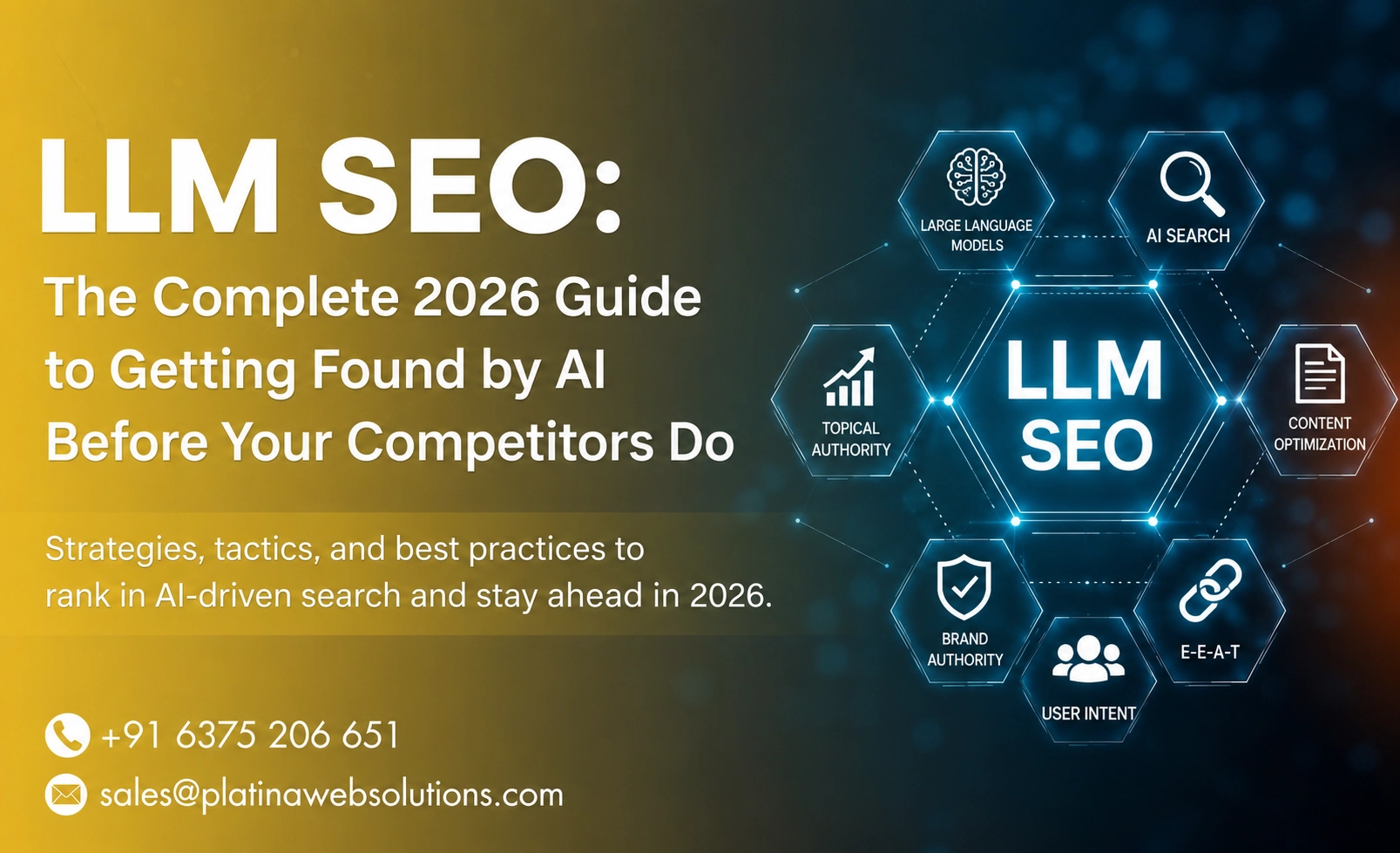
LLM SEO: The Complete 2026 Guide to Getting Found by AI Before Your Competitors Do
- Share :


The way people find businesses online is changing behind the scenes, and most businesses aren't ready for it.
Not long ago, the best ways to get found on Google were to master keywords, get backlinks, and move up the rankings. That's still important. Now, though, there's something bigger to see. More than a million people now use AI assistants like ChatGPT, Google's AI Overviews, Perplexity, and Microsoft Copilot to ask them direct questions. They only read one answer instead of looking at ten links. That answer either has your brand in it or doesn't.
We won't have to worry about this in the future. It's happening now. Artificial intelligence (AI) answers are already shown instead of normal results in more than 40% of Google searches, and ChatGPT handles more than 10 million questions every day. You can tell those brands are there for a reason. Because of Large Language Models, generative AI, and a whole new set of rules for optimization, they have changed how they write content to fit the new world.
It describes that new truth, how it works, and what you need to do to handle it.
What is LLM SEO?
LLM SEO stands for "Search Engine Optimization for Large Language Models." AI language models (the technology behind ChatGPT, Google Gemini, Claude, and other programs) can find, cite, and suggest your brand when people ask questions that are related to it. This means that you have to make and organize your content in a certain way.
There are a lot of practices that go into this that are all linked. This means writing content that directly and clearly answers the questions of your audience in a way that an AI can understand and use without having to rewrite it in a weird way. To build a well-known brand, you need to make sure that your name is always linked to your area of expertise in knowledge systems, databases, and third-party platforms. This goes beyond just your website.
It means using citations from outside sources that you can trust so AI models can see for themselves that you can be relied on.
AI parsers should know more than just what your page says. They should also know what it's about, who wrote it, and why they should believe it. Structured data and schema markup can be used to do this.
How Does ChatGPT Find Websites? & How Does Chatgpt SEO Service Works?
This question is wrong for most brands. People think that ChatGPT is like Google because it crawls the web, rates pages, and ranks the results. It doesn't. To make your site better for AI, you need to know how it finds and cites content.
ChatGPT finds out about your brand in several ways.
- The first is the data it learns from. OpenAI trains its models on a huge collection of text from all over the internet. That data probably includes pages that were seen as reliable, used a lot, and clearly written before the model's training cutoff. This means that your past credibility is important. Brands that have been building trustworthiness online for years are ahead of the game.
- You can also connect by browsing at the same time. When the browsing feature of ChatGPT is turned on, it searches Bing for a question, gets the top results for that question, and then puts together an answer on the spot from those pages. Search-Augmented Generation, or RAG, is the name of this method, and modern AI assistants are using it more and more. It means that if you do well on Bing for a relevant search query, ChatGPT is likely to list you as an answer to that query. Visibility on Bing, which most brands haven't cared about before, is now a strategic issue.
- The third channel is for recognizing entities. AI models search for more than just pages. They also see brands, people, businesses, and ideas as separate things. The AI can confidently and correctly refer to your business if it has a Wikipedia page, a Wikidata record, consistent information listed across directories and review platforms, and repeated mentions on trustworthy third-party sites. Brands that only exist on their website and don't leave any other traces are hard to recognize as real entities.
- Fourth, and maybe most underrated, channel is third-party citations. When well-known news outlets, trade magazines, academic sources, or review sites talk about your brand, AI models see that as independent proof of your credibility.
One mention in a well-known blog in your field can get more people to see your AI than dozens of pages you wrote yourself. This is why earned media and digital PR have become such important parts of modern LLM SEO strategy.
AI SEO vs Traditional SEO: Understanding the Difference
Both traditional SEO and AI SEO can work together. The smartest brands use both because they are different tools made for different tasks. Mixing them up, using old SEO methods on new AI platforms or not using old SEO methods at all in favor of AI strategies, is a mistake that hurts visibility on both fronts.
- Traditional SEO is mostly about putting documents in order of importance. Backlinks, keyword relevance, page speed, mobile usability, and structured data are all signals that affect where your page shows up in a list of results. People see that list, pick a link, and go to your site. To be successful, you need a lot of traffic.
- The main idea behind AI SEO is to find answers. An AI assistant pulls answers from a number of different sources when a user asks it a question. People may mention your brand by name, use it as a starting point for an explanation, or suggest it as a solution, and they won't even have to click through to your website. Not traffic in the usual sense, but brand visibility and the number of times it is cited are what measure success.
- The content that these two approaches need is really different. Traditional SEO likes long-form content that is thorough, full of keywords, and meant to rank for a lot of related terms and meet a lot of search intents on a single page. AI SEO rewards writing that is clear, concise, and conversational and that answers a specific question in a clear and authoritative way. In Google, a 3,000-word article full of semantic keywords does well. In ChatGPT, a 400-word answer to one question that is completely clear does well.
- The metrics are also not the same. When brands do traditional SEO, they keep track of their rankings, click-through rates, and sessions of organic traffic. When brands use AI for SEO, they keep track of how often their name shows up in AI-generated answers for specific queries, how many times their name is mentioned across AI platforms, and what is becoming more commonly known as "AI-influenced revenue": sales from people who found the brand through an AI assistant and then searched for it directly.
Brands that invest in both approaches see a 3.1 times higher share of voice across search and AI channels than those using only one.
What is Generative Engine Optimization (GEO)?
The field of LLM SEO includes Generative Engine Optimization (GEO), which is a more specific and research-based framework. LLM SEO talks about how to optimize for AI language models in general, while GEO is more focused on how to get citations inside AI systems that make completely new answers, such as Google AI Overviews, ChatGPT with browsing, Perplexity AI, and Microsoft Copilot.
The term was first used in a 2023 study from Princeton and Georgia Tech that looked at how different aspects of content affected the likelihood of being cited in AI-generated answers. The results were shocking: certain writing choices, structure choices, and authority signals made content much more likely to show up in AI responses, even when traditional SEO signals weren't present. GEO turned out to be the best way to use those findings strategically.
Fluency optimization is the main focus of GEO. It means writing content in prose that is clear, natural, and easy for an AI to extract and use without using awkward or jarring language in the final response. Even though this seems like a small change, it's a big one for many brands that are used to writing for machines instead of people.
Researchers call publishing original data, research, and statistics that other sites reference "authoritative citation planting." This makes your content a primary source that AI models naturally gravitate toward. It has prompt-aligned content, which means that each page is written to match the exact question structures that people type into AI assistants. A short, 40–60 word direct-answer summary should be placed at the very top of each key page. This is called "snippet engineering," and it gives AI systems exactly what they need to come up with a confident answer.
The Princeton–Georgia Tech study found that these GEO techniques increased AI citation rates by up to 40% compared to unoptimized content. That difference is the difference between being found and not being seen for brands in competitive categories like health, finance, legal, home services, and technology, where AI Overviews now dominate the results.
A publisher of health information was slowly losing organic traffic to Google AI Overviews, which gave medical answers without citing any sources. Platina Web Solutions rebuilt their content architecture based on GEO principles. Each article now has original research summaries, expert author attributions with schema markup, and direct-answer introductions. Google's AI Overview used their content in 67 out of 100 target health queries in the first 90 days. People were looking for the source of the answers they were reading, so direct brand searches went up by 38%.
The Future of LLM SEO Services in Jaipur,India
We are really just starting this change. The changes we see in search behavior right now are just the beginning of a much bigger change in how people find brands, weigh their options, and make choices.
Every month, a number of changes are coming together to make LLM SEO more important. AI-generated answers are quickly becoming the standard way to ask for information. This isn't just a cool new feature; it's how a growing number of users, especially younger ones, choose to find information. More than 70% of all search interactions will likely be affected by responses made by AI by 2027. The brands that are making AI more visible right now are building an authority advantage that gets stronger over time and harder for new brands to overcome.
At the same time, the technology behind it is moving toward retrieval in real time. In the future, AI models will not use a fixed training dataset, but will instead search the live web for every answer. This changes LLM SEO from a one-time optimization effort to an ongoing content strategy. Brands that consistently publish new content, update old content, and keep their external citation profiles active will have a structural advantage over those that only optimize once and wait.
Another important factor is personalization. Future AI assistants will give users answers that are specific to them based on where they are, their history, and the current situation. For different users, the same search query may bring up different brand citations. Being seen as a trusted source across your whole category is more valuable than having a single optimized page because of this.
MarketsandMarkets (2025) says that the global market for AI in marketing will reach $107.5 billion by 2028, growing at a rate of almost 29% per year.
According to Gartner (2025), 82% of enterprise marketers already have plans to spend more on AI search optimization in the next 12 months. Moving early is possible now, but it won't be for a long time.
In early 2025, a national store chain started to put money into LLM SEO. Platina Web Solutions made a 12-month plan based on original buying guides, content that teaches about products, and expert editorials that were made to be cited by AI. By the first quarter of 2026, AI assistants were using their content in 19% of category-related queries. This was more than their closest competitor had achieved at that point. Revenue increased by 64% year over year thanks to AI.
Final Word
In real time, the search rules are being changed. No longer are LLM SEO, Generative Engine Optimization, and AI-first content strategy just wild guesses. They are now essential for any brand that wants to stay competitive for the rest of this decade.
The good news is that the rules for good LLM SEO are the same rules for good content: be clear, be trustworthy, and be truly useful. Knowing how to organize and share that content in a way that AI systems can recognize, trust, and recommend you makes all the difference.
That's what we help brands do here at Platina Web Solutions. Get in touch with us right away, and we'll help you get ahead of your competitors in AI search.
FAQs
Q1. Do I need to choose between traditional SEO and LLM SEO?
No. They both do different things that overlap. A lot of traffic comes from ranked links in traditional SEO. LLM SEO makes brands more visible in answers made by AI. The 2026 winners will put money into both and let them work together to make the other stronger.
Q2. How quickly can LLM SEO produce results?
Within 60 to 90 days of consistent implementation, most brands start to see improvements in the number of citations and AI-influenced brand searches. Over the course of six to twelve months, you gain a lot of authority.
Q3. Is LLM SEO relevant for small and local businesses?
There is less competition for AI citations in local and niche queries than in broad national categories. When it comes to the questions that matter most to nearby customers, a small business that consistently ranks high in AI in its market can do better than much bigger national competitors.
Q4. Where do I start?
Start by looking at the content to find pages that can be reorganized so that direct answers can be found. Put in FAQ schema and clear 40–60 word answer summaries at the top of important pages. Then, submit your site to Bing Webmaster Tools and start getting reliable outside references. You can get a free LLM SEO readiness assessment from Platina Web Solutions to find your best opportunities.
In a Nutshell
LLM SEO is the process of optimizing your website and content so that AI-powered search engines and large language models (LLMs) like ChatGPT, Gemini, Claude, and Perplexity can discover, understand, and recommend your business. Unlike traditional SEO, LLM SEO focuses on semantic relevance, authority, structured data, brand mentions, and high-quality content that directly answers user questions. As AI-driven search continues to grow in 2026, businesses that adapt early can gain visibility, generate qualified leads, and build trust before competitors. Implementing LLM SEO strategies today ensures your brand remains discoverable in the future of search and AI-powered recommendations.

About The Author
Platina Web Solutions
Platina Web Solutions holding rich experience of Handling Web and App Development Projects. Over the years, we have helped several startups and enterprises by delivering them with top-notch website development, software development solutions and result oriented digital marketing strategies. If you have any project in mind, feel free to get in touch with our sales team or call +91-6375206651